
An article from Fitness Karma
Fitness Karma: A Fast Workout Log for Lifters
Fitness Karma is a fast, private workout log for lifters who want to track sets, reps, weight, rest, history, and progress without extra clutter.
You already know what you are doing today: deadlifts, presses, pull-ups, or whatever your program calls for. What you need between sets is a quick way to record the work, see what you did last time, and get back to training.
Fitness Karma is a workout log for lifters who already know how they want to train. It is not a coach, a social feed, or a calorie tracker. It is a practical place to keep sets, reps, weight, rest, and the history that makes the next workout easier to start.
Log the workout in front of you
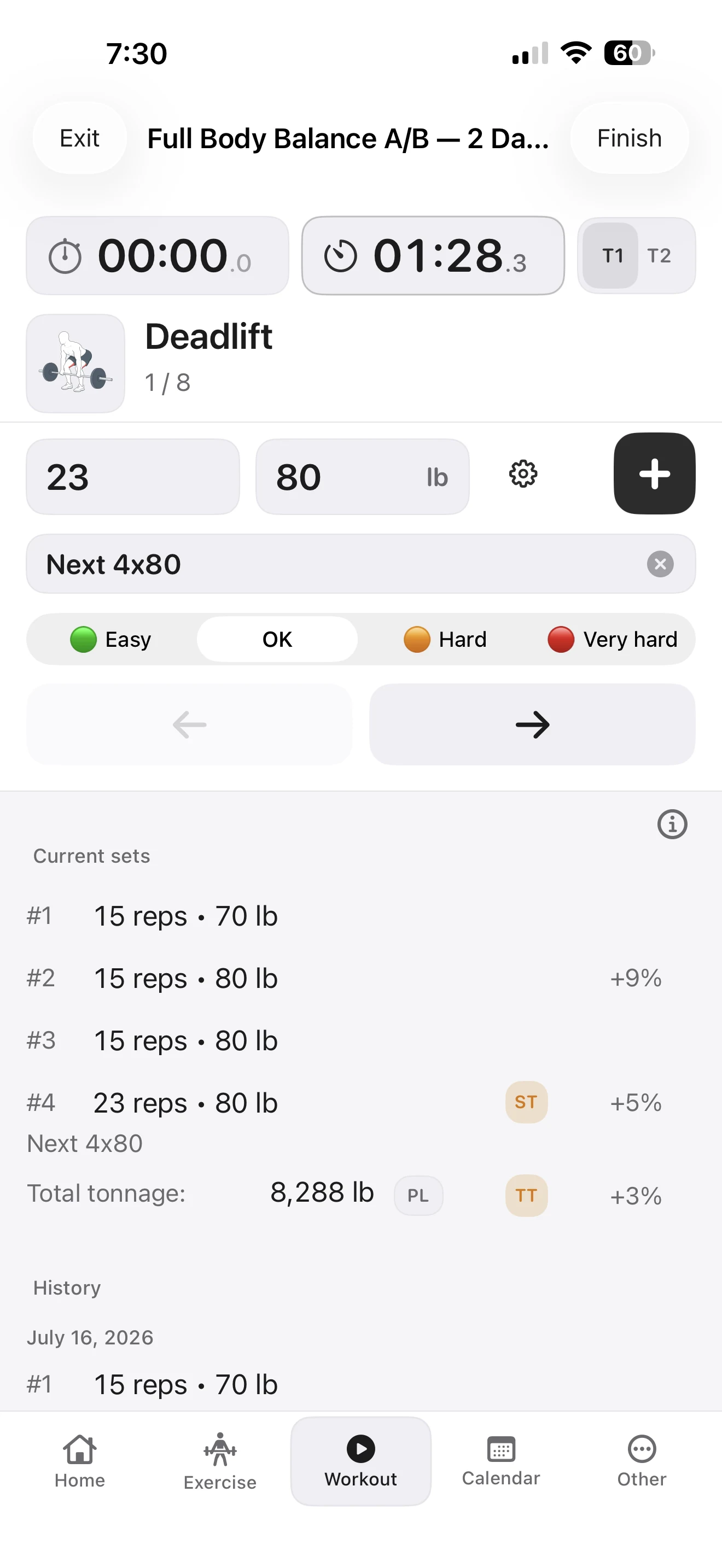
During an active workout, Fitness Karma keeps the immediate details together: the exercise, the set you are about to log, the completed sets, and the previous context that may help you repeat your setup. When auto-rest is enabled, the timer can begin after you log a set. You can also add a simple difficulty note—Easy, OK, Hard, or Very hard—without turning the session into a score.
The point is not to collect more data than you need. It is to make the useful record easy to reach while you are actually in the gym. For the full in-gym flow, see How to Log a Workout in Fitness Karma.
Log weights the way your equipment is set up
The number you want to remember for next time is not always the whole load behind a set. You may remember one dumbbell, one side of a machine, or the plates you put on a bar. In a US gym, a kilogram bar with pound plates can make even a familiar lift feel like a small math problem during a rest period.
Fitness Karma lets you enter the setup in a way that makes sense at the equipment, then resolves the relevant load for its records and training-volume calculations. The detailed choices for dumbbells, machines, barbells, plates, and mixed units belong in How Load Modes Work in Fitness Karma.
Keep bodyweight work in the record
Not every meaningful set starts with a number on a pin or a plate. Pull-ups, dips, push-ups, assisted variations, and partial-bodyweight movements still belong beside the rest of a training history.
Fitness Karma can record bodyweight, assisted, and partial-bodyweight exercises in the same workout record. For the details of how those exercise types are recorded, see How Fitness Karma Tracks Bodyweight, Assisted, and Partial-Bodyweight Exercises.
See the record build over time
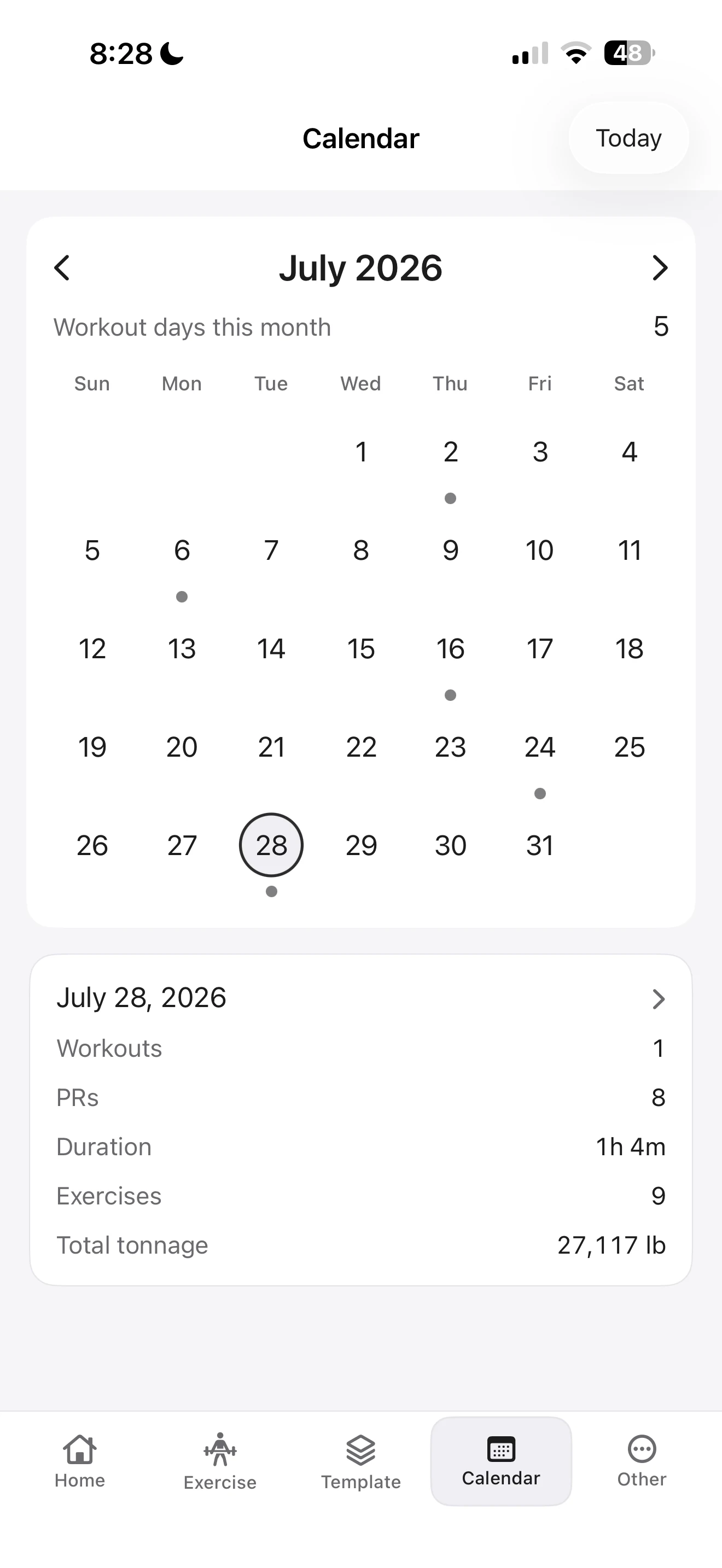
A workout log becomes more useful after the workout is over. Fitness Karma keeps workout history, exercise records, calendar entries, and personal-record milestones close enough to review without rebuilding the session from old notes. It can also show the result of the work you logged, including training volume and total weight lifted where those measures apply.
Those numbers are context, not a score for your training. Training volume is one way to review recorded work beside your sets, reps, weights, and history; it does not measure technique, recovery, calories, or how much muscle a workout will build. For a closer look at that record, see How to Track Progress With Workout History, PRs, and Calendar.
Start with structure, then make it yours
If you want a starting point, Fitness Karma includes system templates. Make an editable custom copy instead of changing the original. If a movement is not in the library, create a custom exercise for it.
That keeps the structure useful without forcing every session into someone else’s exact list. See How to Start With a Workout Template in Fitness Karma and Make It Your Own, or How to Create a Custom Exercise in Fitness Karma when you need to add your own movement.
Keep your history close—and recoverable
A long-term workout record only helps if you can keep using it. Core workout flows work locally, without internet and without a Fitness Karma account. Backup options provide another layer of protection for the history you build over time.
That is not live cross-device synchronization or automatic merging. It is a way to protect and restore your record when you need it. Read How to Back Up and Restore Workout History for the backup and restore details.
A workout log for the part between sets
Fitness Karma is for the person who already has a routine and wants a calmer way to keep it. Log the set. Check the last one. Let the app handle the awkward parts of the record. Then get back to training.