
An article from Fitness Karma
How to Track Progress With Workout History, PRs, and Calendar in Fitness Karma
Track gym progress with workout history, personal records, calendar, and training volume in Fitness Karma without guessing.
The hard part of tracking lifting progress is rarely writing down one set. It is remembering what happened after several weeks: whether the last squat session had the same reps, whether a new set was actually better, or when you last trained at all.
Fitness Karma keeps those pieces connected. You can compare a current set with the previous finished workout that used the same exercise, review the completed session, notice personal records, and use the calendar to see the training days you actually logged. The record gives you context; it does not tell you what weight to use next time.
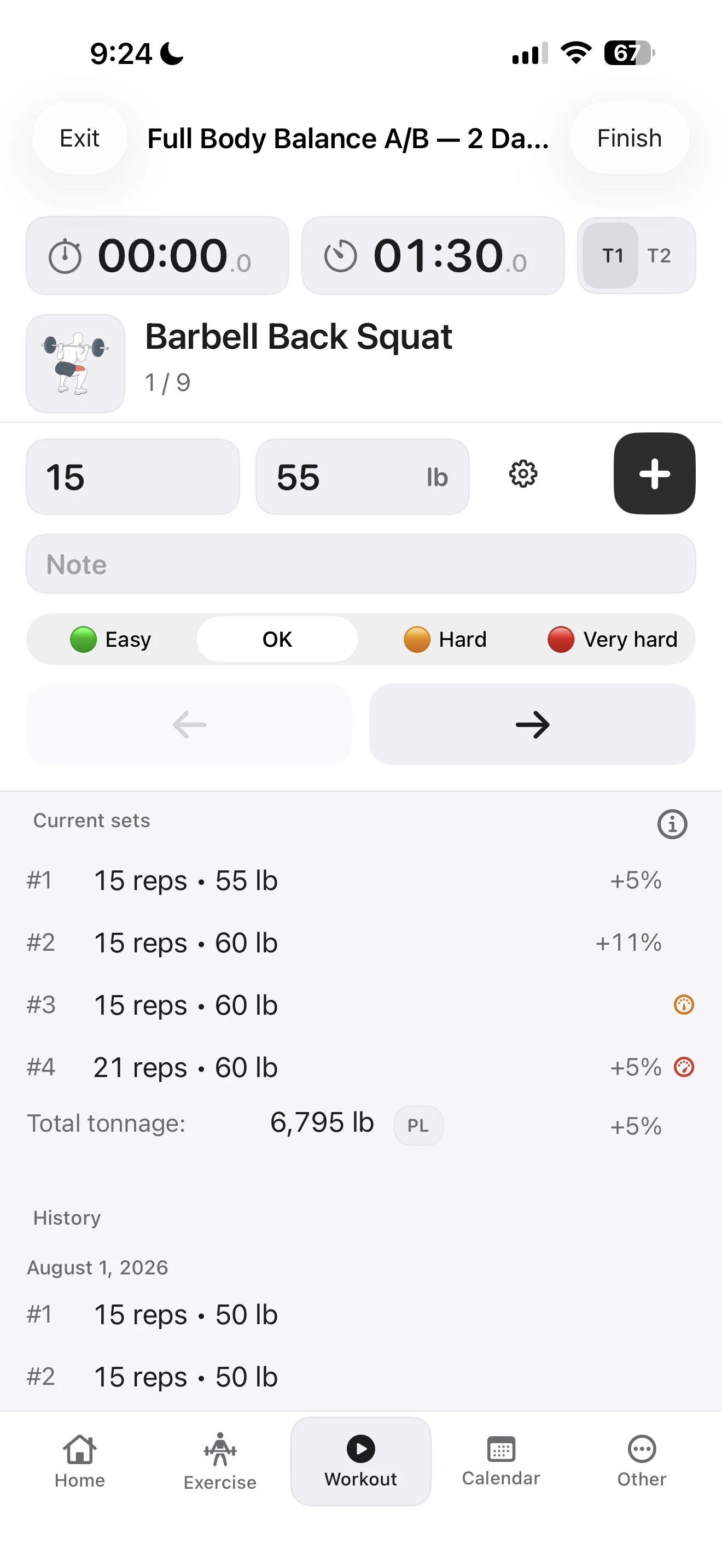
Compare today with the previous matching workout
In an active workout, Fitness Karma looks for the previous finished workout that included the same exercise. It then compares the current set with the set at the same position in that earlier workout.
That detail matters. The first current set is compared with the first prior set, the second with the second, and so on. If you add a set with no equivalent prior set, the app can show +100%. If there is no useful prior value — for example, it is missing or zero — no percentage is shown instead of inventing a comparison.
What the percentage represents depends on the exercise's metric. For Reps + weight, it uses tonnage. For Reps only, it uses tonnage when that is available and otherwise total repetitions. Matching time and distance exercises use duration or distance. Band-assisted and reps-plus-time exercises do not have this comparison.
The displayed value is (current − previous) / previous × 100, rounded for display. Treat it as a compact description of recorded data, not a message that you should add load, match a number, or repeat the previous session exactly. For the actual set-entry flow, see How to Log a Workout in Fitness Karma.
Use history to see the session, not just the final number
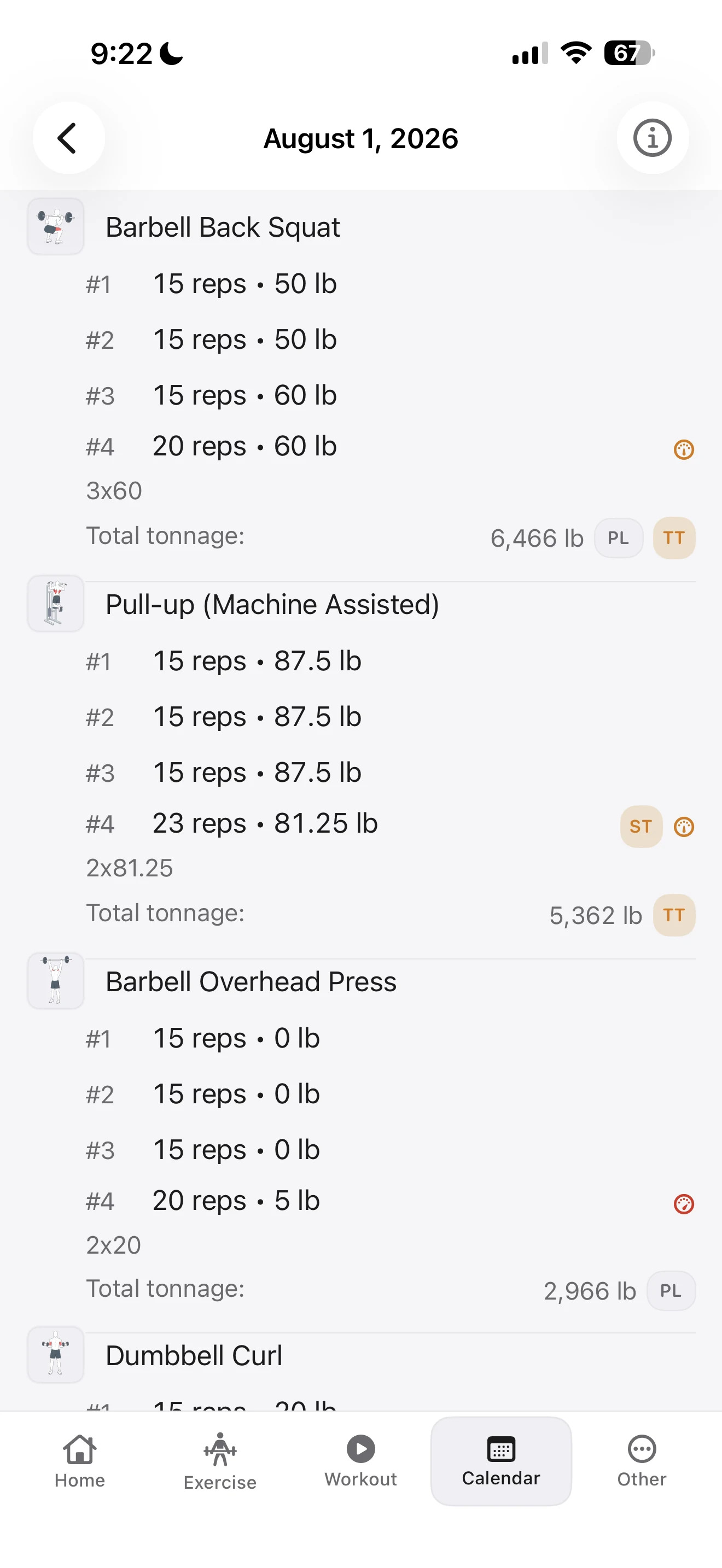
A completed workout keeps more than its total. You can review the exercises, each logged set, applicable load details, and the derived total tonnage for that exercise. That is usually more useful than trying to reconstruct a session from a single number in a notebook.
In the example below, the Barbell Back Squat record shows four sets and its exercise total, followed by the other movements from the same day. The badges are context from the completed record; they do not turn a workout into a scorecard for technique, recovery, or training quality.
You can edit an older workout when you spot a logging mistake. Fitness Karma updates the stored history and recomputes affected personal-record and projection data. That is an edit to the record, not a backup or restore procedure; for protecting and restoring workout data, see How to Back Up and Restore Workout History.
Personal records mark a comparable improvement
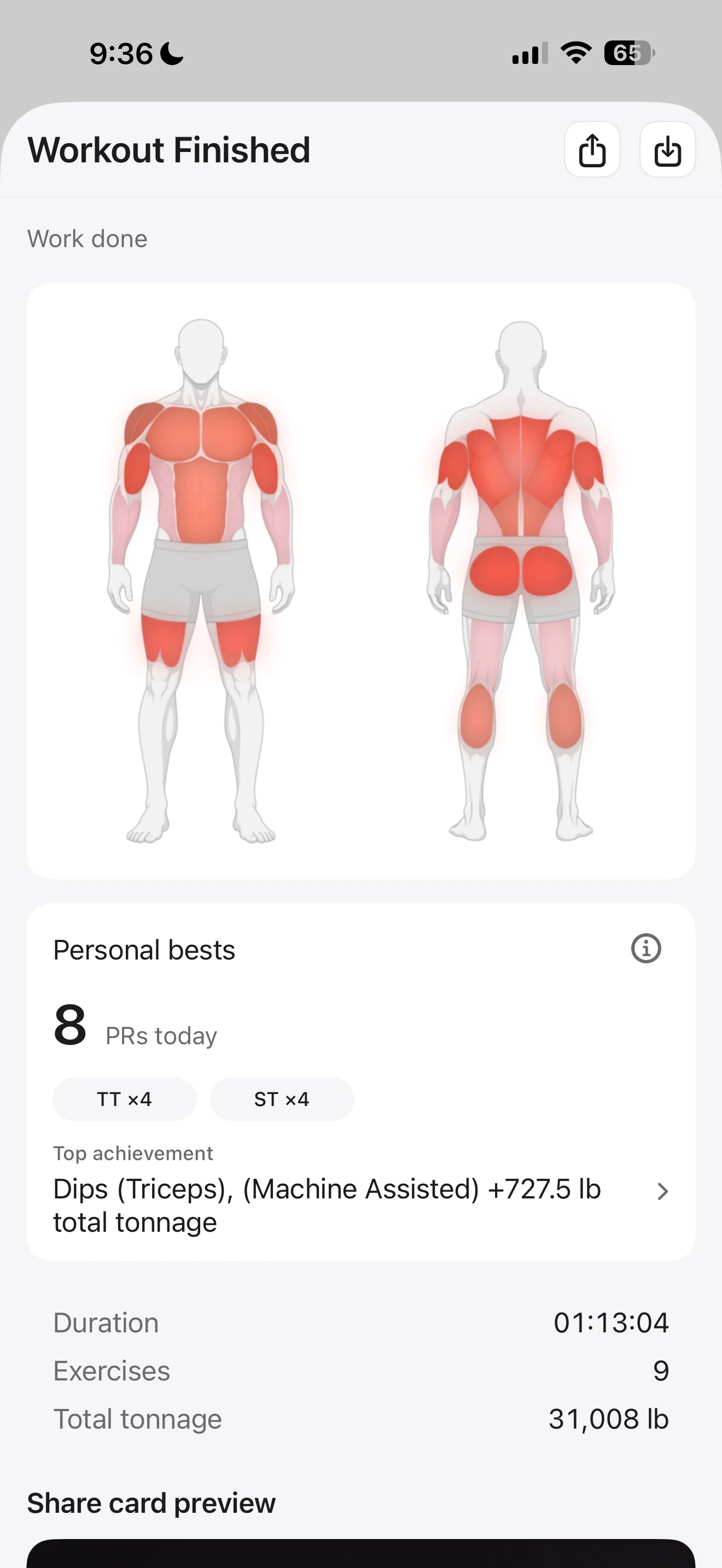
A personal record is a category-specific best from a completed workout. Depending on the exercise and its metric, Fitness Karma can recognise effective weight, best set tonnage, best total exercise tonnage, maximum reps, maximum distance, maximum added weight, maximum duration, or structured reps-and-time performance.
The completion screen only presents PR achievements when a category has a prior comparable value. A first workout or a newly introduced exercise can instead appear as a milestone. In other words, a first logged number is not presented as proof that you have beaten a previous one.
The body atlas is categorical coverage for the completed workout: it shows whether a muscle target was absent, secondary, primary, or primary with a PR. It is not volume-weighted and does not measure muscle activation.
The atlas is useful as a visual summary of the stored exercise targets in that workout. It does not claim to measure how much a muscle worked, how well you performed the movement, or which part of the body needs attention next.
Let the calendar show the record you have
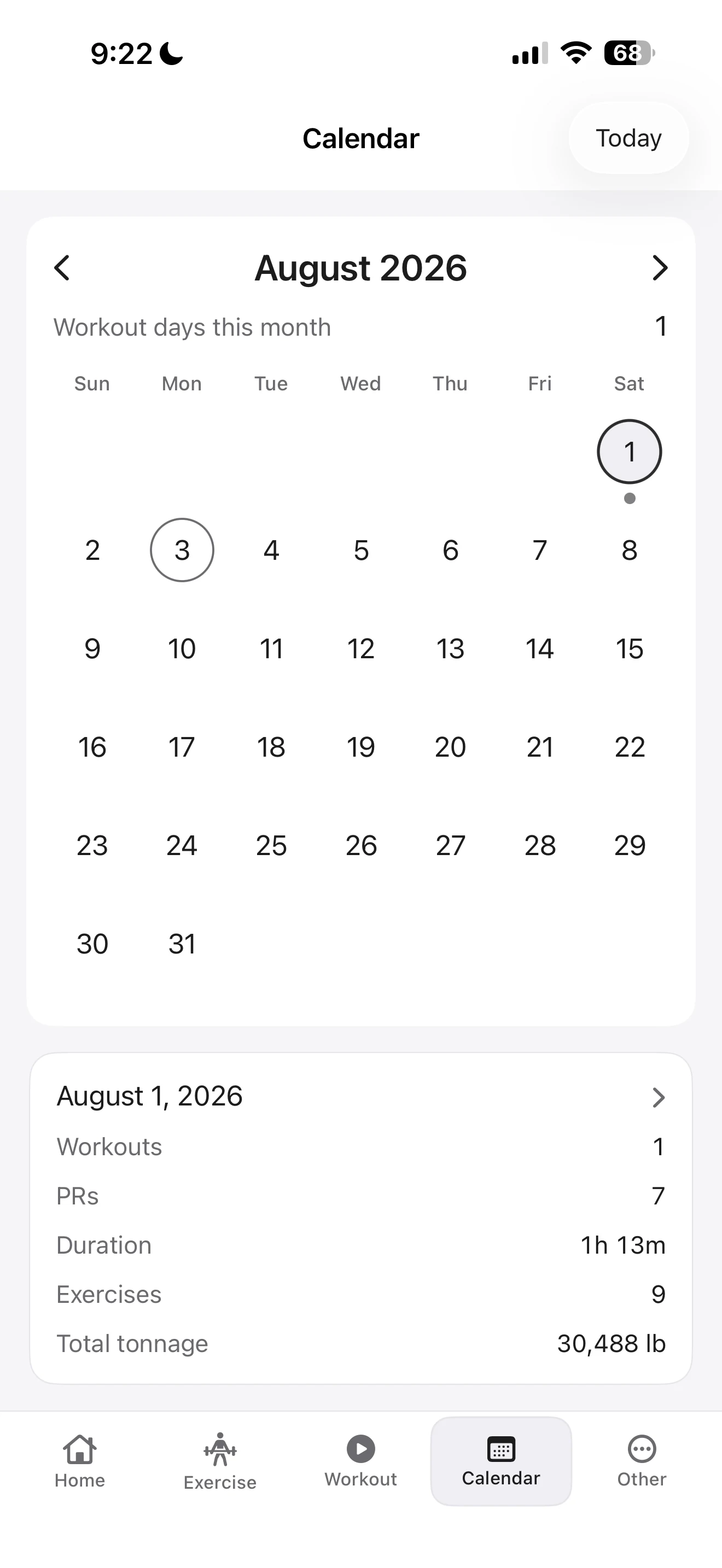
The calendar is a simple way to move from a broad view of training days to a particular completed workout. Select a date with a workout to see its day summary, including workout count, PR-event count, duration, exercise count, and total tonnage. On a rest day, the calendar can also show the previous workout date.
This is useful for noticing gaps and patterns without turning rest days into failures. A quiet week may reflect travel, illness, a deliberate break, or simply a life that was busy. The calendar records what happened; it does not enforce a streak.
Read training volume carefully
Total tonnage is one useful summary of recorded work. It can make it easier to compare your own sessions over time, especially when the exercise list and set structure are similar. It is also why consistent input matters: a total can depend on the load entry selected for that set and, where applicable, the bodyweight model recorded for the exercise.
It is not a universal fitness score. Tonnage alone does not establish technique quality, calorie burn, recovery, muscle activation, or guaranteed growth. If you want to understand how a set's external load is resolved, read How Load Modes Work in Fitness Karma. For full, partial, and assisted bodyweight entries, read How Fitness Karma Tracks Bodyweight, Assisted, and Partial-Bodyweight Exercises.
A small review habit is enough
After a workout, you do not need to turn every number into a verdict. A useful review can be as small as checking the previous matching set before you train, opening the finished workout when something felt different, and looking at the calendar when you want to remember the shape of the month.
That keeps workout history useful: it is a record you can return to when you need context, not an automatic coach deciding what your next session should be. For the wider picture of the app as a private training record, see Fitness Karma: A Fast Workout Log for Lifters.